Reviving the Past, Shaping the Future
Since TAT’s founding in 1971, the firm has championed the importance of the preservation and historic rehabilitation of the nation’s architectural heritage, while honoring its built legacy. Equally important, this work has been integral to the economic growth of cities, fostering equitable environments and functioning as a catalyst for positive change.
Preservation not only enriches our neighborhoods – it is in fact their backbone. With escalating climate
concerns and unsustainable levels of resource consumption, adaptive reuse and rehabilitation interventions remain a vital strategy for mitigating urban sprawl, revitalizing underutilized assets, and optimizing existing infrastructure to create denser, more sustainable cities.
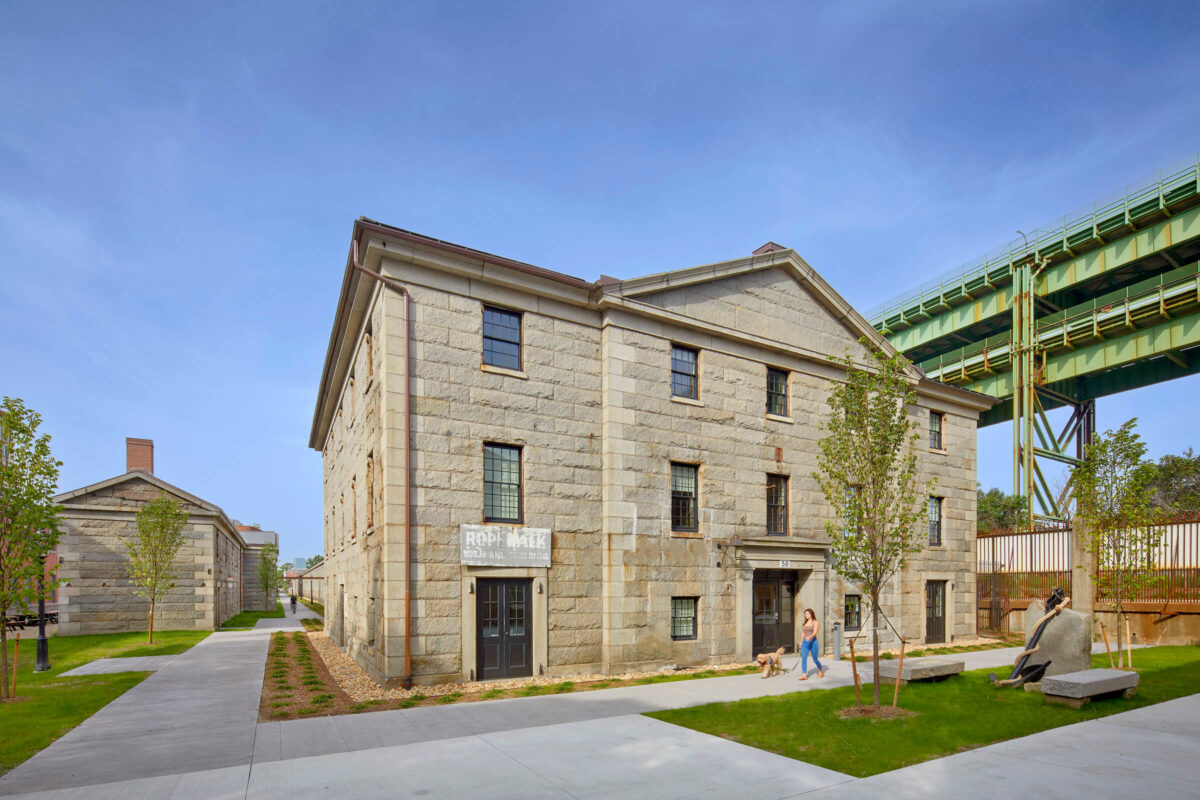
The Ropewalk, listed on the National Register of Historic Places and recently designated as a Boston Landmark, is one such example. The circa 1838 building was originally designed by renowned architect Alexander Parris. At almost a quarter mile long and just 45 feet wide, the granite-faced rope-making facility is one of the last buildings of its kind still standing in the United States. For over a century, the Ropewalk housed the United States Navy’s primary rope laying and spinning operations.
Following the decommissioning of the Charlestown Navy Yard in 1974, the structure remained vacant and derelict for nearly 50 years, ravaged by a series of fires. The firm’s successful rehabilitation transformed the facility into a geothermally powered 97 unit mixed-income multifamily community. Transoms were incorporated
as a design solution to bring adequate daylight into the deep apartments, borrowing natural light from the airy,
single-loaded corridor that runs the length of the structure. Additionally, the restoration of a publicly accessible “flirtation walk” reestablishes a pedestrian connection between the Navy Yard’s internal streets, enhancing the waterfront’s public realm.
The Ropewalk is the most recent of the firm’s five previous historic adaptations in the Navy Yard, and a critical component to the reactivation of the National Park Service site which built, repaired, and resupplied ships for 174 years. TAT’s objective was twofold: to rescue the historic building from a destructive fate and to create a
new forward-looking purpose, thereby preserving the past for the future.
Projects Featured:
- Ropewalk, Charlestown, MA
- Courthouse Lofts, Worcester, MA
- Loft Five50, Lawrence, MA