Now + Next: Raffles Boston
In a dense historic neighborhood, TAT artfully crafts a striking mixed-use tower for global luxury brand’s long-awaited U.S. debut.
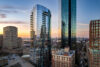
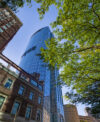
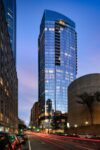
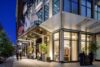
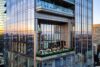
The Raffles Boston Back Bay Hotel & Residences is a new 430,000 square foot luxury hospitality, retail, and residential destination lauded as “the city’s most exciting new hotel opening” by Robb Report. With an inventive cantilevered structure and Boston’s only hotel sky lobby, the 400-foot curved glass tower provides a dramatic new skyline statement within a challenging and historic context. The $400-million-plus, 35-story tower offers 147 guestrooms and 146 condominium units. It is the first-ever mixed-use property in North America for the world-renowned Raffles brand, a part of the Accor world hospitality group. The development team is a partnership comprising Gary Saunders of Saunders Hotel Group, alongside their global development and equity partner Cain International, and Jordan Warshaw of The Noannet Group.
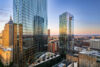
The development represents an ambitious mix of uses, with a design that is particularly sensitive to its surrounding context – the historic Copley Square and iconic Hancock Tower. The exterior is sculpturally distinctive and explicitly designed to set itself apart from the neighboring buildings. Our aim was to bring new design energy to the skyline, a fresh vitality to the area, and capture the distinctive personality of Boston while honoring the impeccable luxury and legendary hospitality synonymous with the Raffles brand.
Michael Liu, AIA, NCARB, Principal Emeritus
Recognizable for its scale and refined, curved profile, the Raffles Boston Back Bay & Residences creates a dramatic presence at the street level and across Boston’s horizon. In a neighborhood defined by a dense low-rise historic architectural fabric and the iconic 60-story, 790-foot-high John Hancock Tower, crafting an appropriate design solution and successfully integrating the structure into the context posed an intriguing challenge. The site has a modest footprint just 65 feet (20m) from the all-glass Hancock building and is adjacent to a historic landmark, the 100-foot-tall University Club. Transforming the narrow urban site required securing air rights over the historic neighbor, demolishing the existing eight-story Boston Common Hotel and Conference Center, and separating its steel structure and walls from the University Club. This allowed for an innovative solution by structural engineer McNamara Salvia. At the new tower’s fourth floor, above the party wall with the University Club, a bold 30-foot cantilever now extends overhead and supports the tower’s upper 29 stories – another 340 feet into the sky, with a second cantilever at the 17th floor. To support the cantilevered structure, a dense field of six-foot-wide caissons was then drilled into bedrock, approximately 120 feet, followed by 1.5 million pounds of steel plate girders and more than 1,428 cubic yards of concrete for the building’s seven-foot-thick mat slab. The approach yielded both programmatic and urban design benefits, granting the tower a contextually scaled street presence while also allowing the building to express itself as a sculptural form on the upper levels.
Another critical design challenge arose from the Raffles tower’s proximity to the Hancock; the aim was to not only visually differentiate the new structure but also accommodate the extraordinary wind conditions resulting from the Hancock’s scale and orientation. To address these considerations, TAT’s designers arrived at the Raffles tower’s elegant profile, effectively responding to the intense wind load. “We chose glass curtainwall assemblies whose color provided a harmonious contrast to the Hancock while also granting an optimal mix of vision and reflectivity for both residential and hotel uses,” explains Alexander Donovan, LEED AP, Senior Project Manager, responsible for the day-to-day delivery of the project.
The complex process behind the cantilever design serves as a testament to the deeply collaborative approach that defined the entire Raffles project from start to finish. This landmark development, with a one-of-a-kind hospitality offering, called for unusually complex design and construction techniques – resulting in a design that seamlessly blends the qualities of global and local influences, intricately woven into the close-knit fabric of the Back Bay.
Gary Kane, AIA, NCARB, LEED AP BD+C, Principal
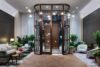
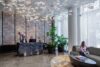
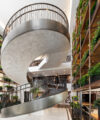
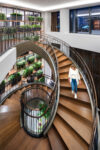
With a mixed-use program as complex as its architecture, the project team deployed an equally creative approach to the building’s interiors, generating a workable mixed-use program to meet the ambitious objectives of 16 distinct gathering spaces, including a variety of special venues dedicated solely to building residents. Upon entering the Raffles hotel lobby, guests ascend to the 17th floor and its Grand Stair — an iconic signifier of the brand — which spirals through the three-story Sky Lobby. Designed to serve several essential functions, including as a reception area, this light-filled space connects guests for socializing and offers four distinct food and beverage venues. Dining experiences include Amar by Chef George Mendes, the Long Bar & Terrace, a Paolo Ferrari-designed lounge with panoramic views of the South End, a moody two-floor Speakeasy and Writer’s Lounge, and a 3,000 square-foot ballroom with sweeping views of Boston. The 4th floor hosts an exclusive state-of-the-art gym, a 66-foot (20m) indoor pool, and the prestigious Guerlain Spa at Raffles Boston.
For Raffles’ residents, a separate yet equally compelling entry sequence begins with a set of elegant, custom wooden doors leading from the street to a dedicated lobby. Residents-only elevators bring homeowners directly up to the condominium levels at floors 15-16 for the pieds-à-terre, floor 21 for typical residences, and floors 34-35 for penthouses. Located on the 21st level is a private amenity space fitted with a library, sports lounge that includes a golf simulator, dining room, tasting kitchen, and secret garden. This level’s south-facing terrace, with its interior-exterior fireplace, provides the residential amenity spaces with a further connection to the South End neighborhood. “A broad range of luxurious amenities and shared spaces is essential to the Raffles brand. These elements are strategically programmed throughout the new tower with a deliberate arrangement that establishes a cohesive interior program, reflecting a carefully considered choreography of spaces and ensuring an exceptional experience for a diverse group of end users,” says Kim McDonald, AIA, project architect.
Similarly, the tower’s curved form provides remarkable views from each guestroom and condominium unit. The design’s radial plan allows individual guestrooms and amenity spaces to extend outward, opening with wall-to-ceiling windows that increase natural daylight and offer panoramic views. The striking glass and aluminum exterior forms a distinctly modern impression, while the intimate and welcoming interior refuge is as timeless as Boston itself.
PROJECT TEAM
- Hospitality Design Firm: Stonehill Taylor, designer of the hotel restaurant interiors as well as several hotel amenity spaces
- Interior Designer: Rockwell Group, designer of the fitness center, spa, residential amenities, and condominium unit interiors
- Retail Design Team: Studio Paolo Ferrari, designer of the Long Bar venue
- General Contractor: Suffolk Construction
- Structural Engineer: McNamara Salvia