
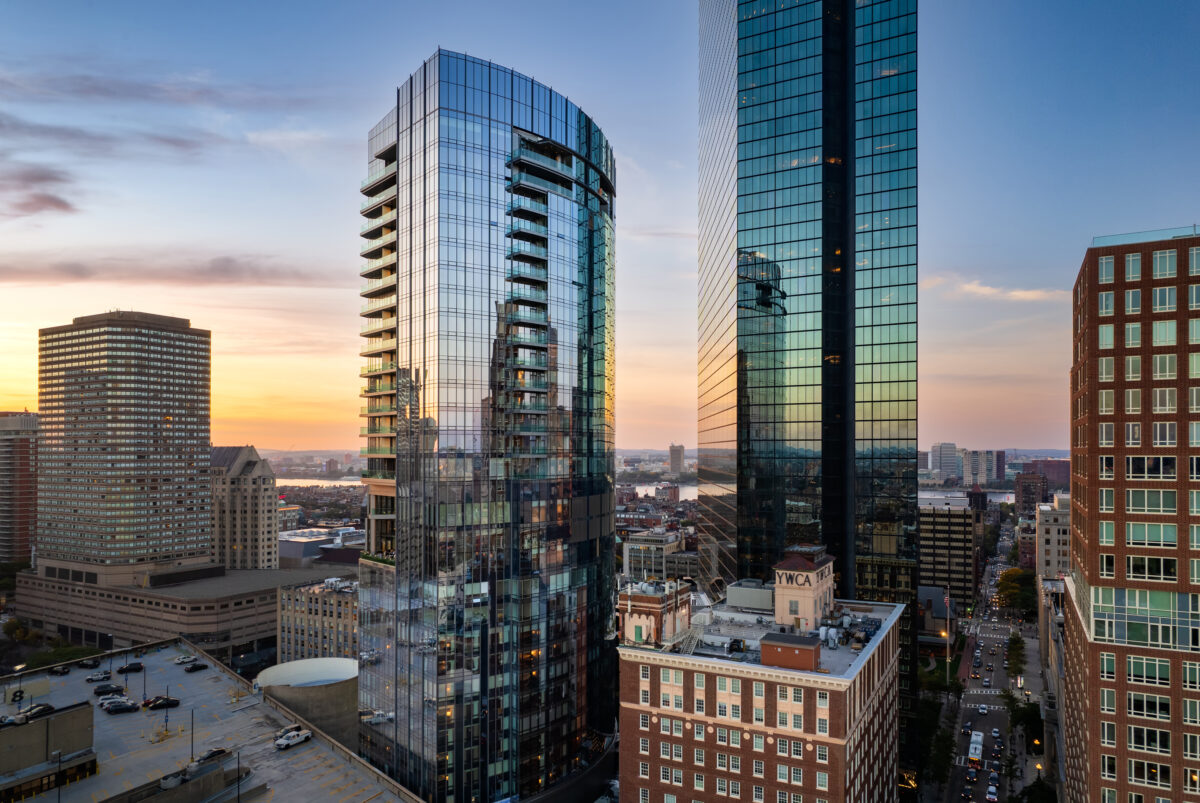
At Raffles Boston, Clever Architecture Makes a Tight Site Work
PRESS ADVISORY
In Boston’s historic Back Bay neighborhood, a striking new 35-story tower has made waves as the first U.S. location for famed luxury hotel brand Raffles.
Yet the $400-million-plus project, designed by architects The Architectural Team (TAT), is equally notable as a case study in navigating persistent challenges facing high-rise construction in dense urban settings.
What can other design teams, real estate developers, and hospitality leaders learn from this high-profile high-rise?
Offering expert insight and valuable best practices, the architects at TAT including can describe the architectural solutions that made this new tower possible on a modestly scaled building site with a number of significant constraints. These solutions include:
- A cantilever structure that extends the tower’s upper floors 25 plus feet over an adjoining historic landmark, allowing the building to meet significant floor-area goals despite a very compact building lot.
- An airfoil-shaped building profile determined through extensive wind-tunnel testing that effectively calms strong winds coming off the adjacent Hancock Building, Boston’s tallest building that is only 65 feet from the Raffles tower. Raffles Boston also features an exactingly designed curtainwall facade that delicately balances opacity and vision, addressing the very different glazing demands of hotel and residential uses.
- An unusually complex interior program incorporating multiple entry sequences and upper-level, multi-story “sky lobbies” for the building’s different uses, which include 147 hotel rooms, 146 residential units, and shared amenity spaces including an indoor pool and several restaurant venues. TAT’s clever radial interior plan ensures that residences, guestrooms, and amenity areas alike all have access to maximum daylight and exceptional views.
With experience designing high-rise towers in a range of urban settings, as well as new construction and adaptive reuse boutique hotels at a variety of scales, TAT’s experts — including principals Michael Liu and Gary Kane, senior project manager Alexander Donovan, and project architect Kim McDonald — are also available to share insight on key trends shaping today’s tall buildings and hospitality destinations. In addition to TAT as the architect, the Raffles Boston design team includes Stonehill Taylor for the hotel interiors, Rockwell Group for the residences, and Studio Paolo Ferrari for the Long Bar F&B venue.
Raffles Boston is the latest in a long line of works by TAT that maximize the value of complex urban sites through creative architectural solutions. Other notable case studies from the firm include 100 Shawmut, a condominium development combining the adaptive reuse of an historic commercial building with an L-shaped contemporary addition; The Archer Residences, a new luxury multifamily development that melds two former university buildings in Boston’s dense, historic Beacon Hill neighborhood into a single structure; and Bower, a two-building mixed-use complex near the famed Fenway Park utilizing air-rights development and a sophisticated urban design scheme to reconnect several neighborhoods long separated by urban renewal.


About Raffles Boston
A Compelling and Complicated Feat of Urban Architecture
Instantly recognizable for its scale and refined, curved profile, Raffles Boston creates a dramatic presence at the street level and across the city’s skyline. In a neighborhood defined by a dense low-rise historic architectural fabric and the iconic 60-story, 790-foot-high John Hancock Tower, crafting an appropriate design solution and successfully integrating it into this context was, as The Boston Globe recently wrote, “an epic challenge.”
The most immediate challenge for the project team was site context, with a modest footprint just 65 feet from the all-glass Hancock building and its adjacency to a historic landmark, the 100-foot-tall University Club. A second consideration facing TAT’s design team involved generating a workable mixed-use program to meet the client’s ambitious objectives of 16 distinct amenity spaces, including a variety of special venues dedicated solely to building residents.
Transforming this relatively narrow urban site into a new standard for urban high-rise architecture required substantial design and engineering ingenuity. In a rare occurrence for Boston real estate development, the project team secured air rights over the historic neighbor, allowing for an innovative solution by TAT and structural engineer McNamara Salvia. At the new tower’s fourth floor, above the party wall with the University Club, a bold 25-foot cantilever now extends overhead and supports the tower’s upper 29 stories – another 340 feet into the sky, with a second cantilever at the 17th floor. The cantilever approach yielded both programmatic and urban design benefits, granting the tower a contextually scaled street presence while also allowing the building to express itself as a sculptural form on the upper levels, with a distinctive freedom of movement not commonly seen in Boston architecture.
Making the Cantilever Work
This solution first required demolishing the eight-story Boston Common Hotel and Conference Center and separating its steel structure and walls from the University Club. In order to support the cantilevered structure, a dense field of six-foot-wide caissons was then drilled approximately 120 feet into bedrock, followed by 1.5 million pounds of steel plate girders and more than 1,428 cubic yards of concrete for the building’s seven-foot-thick mat slab.
“The complex process behind the cantilever design serves as a testament to the deeply collaborative approach that defined the entire Raffles project from start to finish,” affirms TAT principal Gary Kane, AIA, NCARB, LEED AP. “Achieving these innovative solutions required commitment and substantial ongoing effort from the development group, Raffles leadership, and the entire design and construction team. This landmark development, with a one-of-a-kind hospitality offering, called for unusually complex design and construction techniques – resulting in a design that seamlessly blends the qualities of global and local influences, intricately woven into the close-knit fabric of the Back Bay.”
Shaping a Skyline Statement
Another critical design challenge for TAT and its collaborators arose from the Raffles tower’s proximity to the Hancock. Remarking on these additional design constraints resolved by the interdisciplinary team, TAT senior project manager Alexander Donovan explains, “A key challenge was not just visually differentiating the new structure from the iconic Hancock Tower but also accommodating the extraordinary wind conditions resulting from the Hancock’s scale and orientation.”
To address these considerations, TAT’s designers arrived at the Raffles tower’s elegant profile, with its graceful curves effectively responding to the intense wind load and distinguishing the design from its famously angular neighbor. “We thoughtfully chose glass curtainwall assemblies whose darker color provided a harmonious contrast to the Hancock while also granting an optimal mix of vision and reflectivity for both residential and hotel uses,” adds Donovan.
A First-Class Interior Program Reflects World-Class Design Expertise
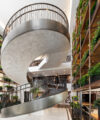
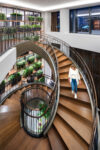
With a mixed-use program as complex as its architecture, the Raffles tower project team deployed an equally creative approach to the building’s interiors. Upon entering Raffles Boston, hotel guests ascend to the 17th floor Sky Lobby, and its Grand Stair — an iconic signifier of the Raffles brand — which spirals through the three-story area. Designed to serve several essential functions, including as a reception area, this light-filled space connects guests for socializing and offers four distinct food and beverage venues. Dining experiences include Amar by Chef George Mendes, the Long Bar & Terrace, a Paolo Ferrari-designed lounge with panoramic views of the South End, The Blind Duck, a moody two-floor Speakeasy, Writer’s Lounge, and a 3,000 square foot ballroom with sweeping views of Boston. The 4th floor hosts an exclusive state-of-the-art gym, a 66-foot (20m) indoor pool, and the prestigious Guerlain Spa at Raffles Boston.
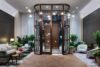
For Raffles’ residents, TAT and the project team designed a separate yet equally compelling entry sequence. The condominium residences are distinguished from other aspects of the building beginning with a set of elegant, custom wooden entry doors leading from the street to a dedicated lobby. Drawing inspiration from the Emerald Necklace parkway and the brownstones that dot the Back Bay neighborhood, the residential palette relies on warm materials, greenery, and a focus on the outdoors. Residents-only elevators bring homeowners directly up to the condo levels starting at floors 15-16 for the pieds-à-terre homes, floor 22 for typical residences, and floors 34-35 for penthouses.
Located on level 21 is a private amenity area designed by Rockwell Group that overlooks the South End and Boston Harbor. Fitted with a Resident’s Library, Sports Lounge that includes a golf simulator, Private Dining Room, Nantucket Cottage Tasting Kitchen, and Secret Garden, this spacious yet intimate area draws inspiration from both a New England aesthetic and the Raffles brand’s Singapore home in its ability to merge high-rise living with the surrounding landscape. This level’s south-facing terrace, with its interior-exterior fireplace, provides the residential amenity spaces with a further connection to the South End neighborhood.
“A broad range of luxurious amenities and shared spaces is essential to the Raffles brand,” says Kim McDonald, AIA, a project architect with TAT. “These elements are strategically programmed throughout the new tower, with many accessible to both hotel guests and full-time residents. This deliberate arrangement establishes a cohesive interior program, reflecting a carefully considered choreography of spaces and ensuring an exceptional experience for a diverse group of end users.”
Similarly, the tower’s curved form provides remarkable views from each guestroom and condominium unit. “We developed a radial plan that allows individual guestrooms and amenity spaces to splay outward, opening to wall-to-ceiling windows that increase natural daylight and offer panoramic views,” says TAT senior partner and principal Michael Liu, AIA, NCARB. In fact, during the project’s early stages, the architects performed extensive studies to ensure that each layout took full advantage of the surrounding city views.
“It’s such meticulous attention to detail that truly distinguishes this project,” concludes Liu. “And while the glass and aluminum exterior forms a distinctly modern impression, the intimate and welcoming refuge we’ve collectively designed is as timeless as Boston itself.”
+++
About The Architectural Team, Inc. (TAT)
The Architectural Team, Inc. (TAT), Is an award-winning architecture firm that has been recognized for its thought leadership and diverse portfolio in architecture, interior design and master planning. Creating lasting transformation in the communities it serves, since it was founded In 1971, the 100-person firm has earned more than 200 awards for design excellence across a broad range of building types and programs. These include new construction of large-scale urban mixed-use developments, multifamily, commercial, resilient waterfront developments, and hospitality projects, assisted and senior living facilities, and community centers.
TAT holds a national reputation in the areas of historic preservation, rehabilitation and adaptive reuse with hundreds of projects that have transformed neighborhoods across the United States, artfully restoring and reimagining neglected buildings for new uses while simultaneously preserving history. Building on its established reputation as a trusted partner in design, The Architectural Team looks forward to future decades of design innovation, client service and creative collaboration. For more information, please visit www.tat1dev.wpenginepowered.com.