
Affordable Housing in a Constant State of Catch-Up
The Diversity of the Affordable Housing Market Give Developers the Opportunity to Target Niches
The article from Building Design + Construction takes a deeper dive into the state of the affordable housing markets and identifies 10 trends based on interviews with multiple AEC firms, including TAT.
By John Caulfield, Senior Editor
In July, a development team started the first phase of Innovative Urban Village, a $270 million project on the 10.5-acre campus of the Christian Cultural Center in East New York, Brooklyn. Phase 1 will deliver 385 apartments for households earning between 30% and 80% of the area median income. Ninety-four of those apartments are reserved for people and families who were formerly homeless and in need of on-site support services. Phase 1 will also offer 17,000 sf of retail and commercial space that includes a grocery store. Eventually Innovative Urban Village will consist of 10 buildings and 1,975 apartments, with no fewer than half of those units earmarked for people and families whose incomes fall within 30-60% of the AMI. About one quarter of the units are reserved for moderate income tenants, 80-100% AMI. The total development cost of this project is pegged at $1 billion.
These kinds of mixed-income, mixed-use projects give market watchers hope that the industry can make headway in reducing the severe shortfall in affordable housing that has confounded developers, their AEC partners, policymakers, and people most in need of housing that isn’t traveling on the residential sector’s current inflationary rocket ship.
“We have vastly underbuilt new housing stock over the decades,” says Lily Trinh Ciammaichella, AIA, LEED BD+C, Associate Principal for the architecture and design firm KTGY. “As a result, we need to continue building a wide range of housing options, including affordable housing to keep our communities accessible and diverse for all income levels.”
“We are seeing an acceleration of every approach that adds to the affordable housing supply. Renovations and moderate rehabilitations have been bedrocks of this sector for years.”
Jay Szymanski, AIA, NCARB, LEED AP, Principal
Affordable housing is covered under a wide umbrella, as are government assistance programs that include tenant vouchers and low-income tax credits for development. Earlier this year, Shelterforce.org, which reports on the affordable housing sector, went beyond the standard definition—that a home is affordable if the household is spending no more than 30% of its income on it—to ask the question “affordable to whom?”
In that article, Shelterforce ticked off no fewer than six categories for affordable housing, based on how the housing was financed, what percentage of their incomes renters or owners are paying, and whether they require supportive services.
Because it targets a cross-section of individuals and families, affordable housing isn’t cookie cutter the way other residential types might be. And what’s getting built often belies affordable’s Spartan reputation. For example, Habitat for Humanity of Greater Los Angeles last summer dedicated the newly completed Holmes Development in South L.A., whose affordable two-story townhomes include two-car garages, drought-tolerant landscaping, solar energy systems, and energy efficient appliances.
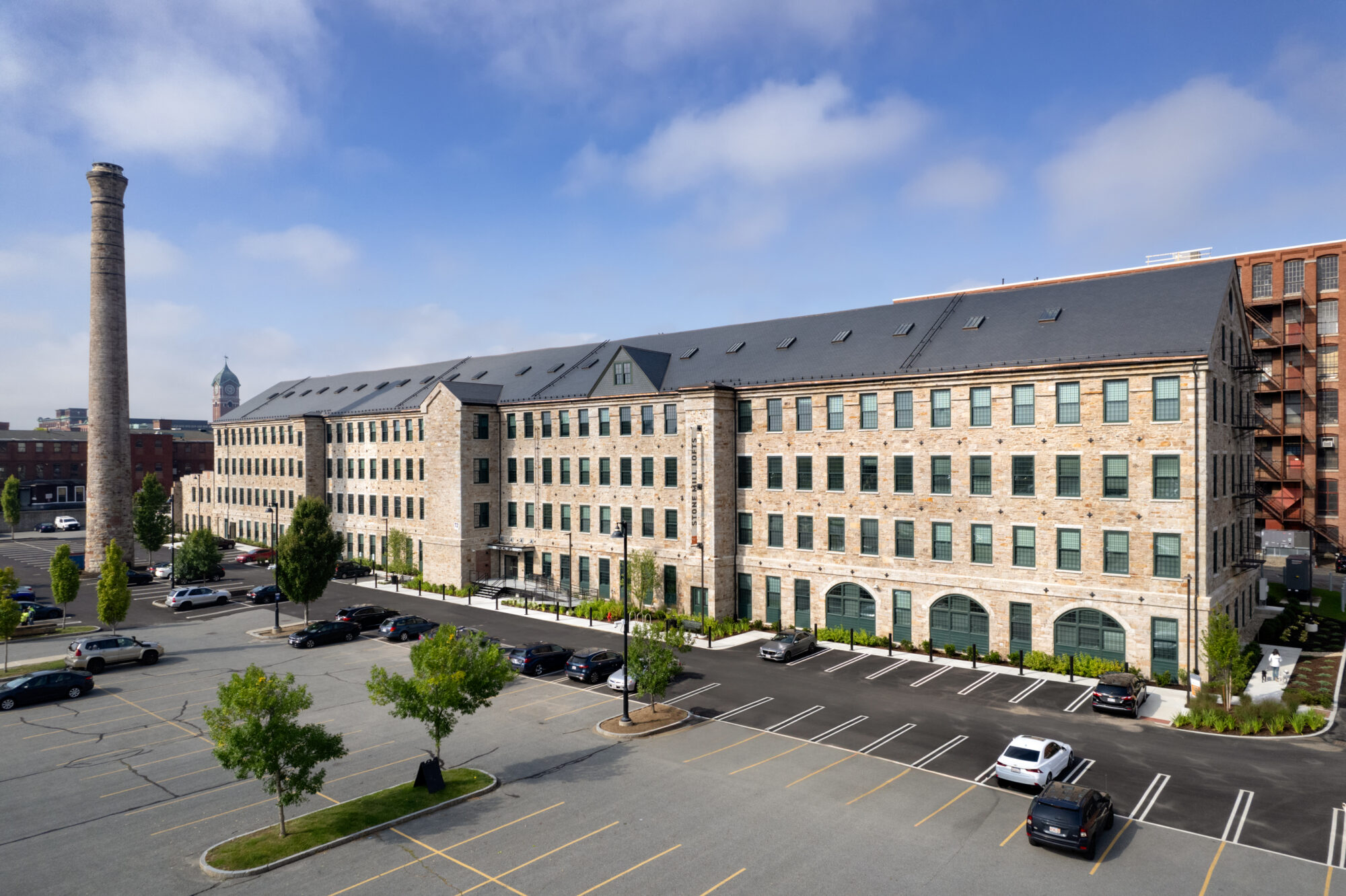
Stone Mill Lofts is a prime example of converting a nearly 200-year-old mill building into an all-electric affordable housing community with 86 rental units that achieves approximate levels of Passive House energy efficiency.
The diversity of the affordable housing market also gives developers the opportunity to target niches. In Chicago, which has the third-largest Native American population in the U.S., the building contractor Skender broke ground in July on Jigzibik, a 62,000-sf, seven-story, mixed-use development with 45 rental units that will become Chicago’s first affordable housing project centered on serving Native Americans. The project—designed by Canopy Architecture + Design, and developed by Visionary Ventures and Full Circle Communities with the Native American Advisory Council—is scheduled for completion in the second half of 2026.
Jigzibik is a Potawatomi word meaning “at the river’s edge,” which might also serve as a good way to describe the direction advocates of affordable housing hope this sector is headed. The following article takes a deeper dive into the state of the affordable housing market and identifies 10 trends based on interviews with and information from more than 15 AEC firms and a recent webinar on this topic posted by Yardi Matrix.
Continue reading the article from Building Design + Construction.

West End Library. Image Courtesy of the City of Boston
10 Trends In the Affordable Housing Sector
- Supply still lags demand, by a lot
- Affordable vs. market rate: the gap closes
- Demand for new builds and renovations equally strong
- More states are clearing paths for project approvals
- Labor is mostly available to keep projects on track
- Developers reconsidering modular options
- Affordable housing is more than just four walls
- To lure workers, employers get involved in housing development
- Funding uncertainties drive P3 solutions
- Wish lists focus on how projects could be streamlined