
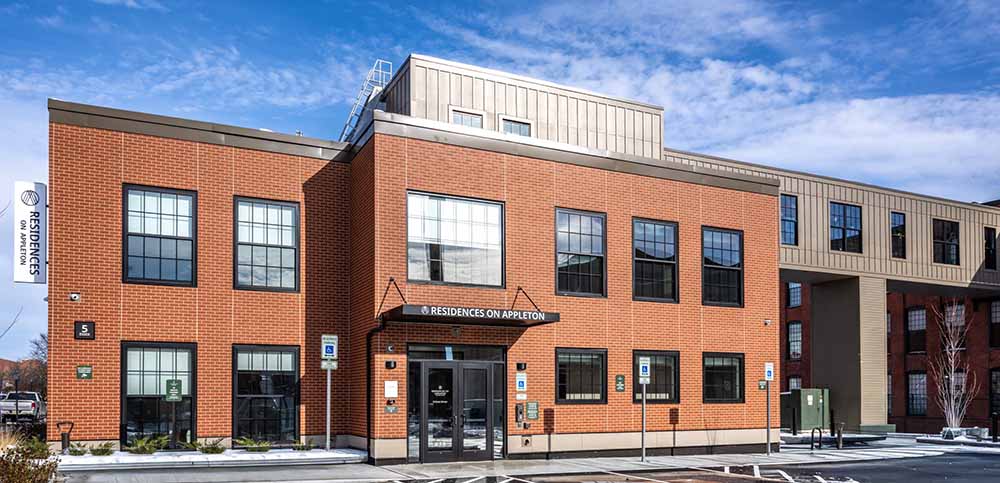
Residences on Appleton - Holyoke, MA - Image by NEREJ
Senior Housing Community Opens After Adaptive Reuse of Historic Mill Complex
Originally built between 1880 and 1920, the historic Residences on Appleton in Holyoke, Mass., formerly home to the Farr Alpaca Woolen Company, is a 168,000 square foot brick mill complex comprised of nine buildings on six acres.
Working alongside our client WinnCompanies, TAT has designed Phase One of the redevelopment which includes the adaptive reuse and restoration of an 86,555 square foot section of the complex made of three structures: Building 4, erected in 1880 and the oldest on the site; Building 5, a storage, washing, and sorting facility erected in 1905; and Building 6, also built in 1905 and the largest structure on the property. The conversion creates 88 units of mixed-income age-restricted housing, and the new construction of a community building connected to the residential building via a closed sky bridge.
Read more about the project in NEREJ’s coverage of the building’s opening below.
“This effort preserved an iconic feature of Holyoke’s proud industrial legacy, created much-needed housing for seniors who want to stay in the community they love, and provided an economic boost to the city’s downtown. We hope to begin work soon on a second phase that will deliver 75 additional apartments in an adjacent part of the complex.”
Larry Curtis, WinnDevelopment Chairman
WinnCompanies has completed a $55.3 million adaptive reuse that transformed a long-vacant, historic mill complex into 88 affordable apartment homes for seniors ages 55 and older.
The project in downtown created Residences on Appleton, featuring new loft-style apartments created within three interconnected, 111-year-old industrial buildings that had been vacant for decades. The community reached full occupancy in December, less than three months after it opened.
All 88 apartments are reserved for low- and moderate-income seniors, with 12 units reserved for households below 30% of Area Median Income (AMI), 63 for those below 60% of AMI, and 13 for households below 80% of AMI. Eight of the units are available to eligible households through the U.S. Department of Housing and Urban Development’s Project Based Voucher program. Five units are set aside for Massachusetts Department of Mental Health clients through the Facilities Consolidation Fund.
Continuing reading the article here.